Education > FAQ
Questions
Beginner Questions
Group Questions
Club Questions
Intermediate Questions
Competitive Questions
Answers
Beginner Questions
1) What is orienteering?
Orienteering is a cross-country running sport, demanding physical and mental fitness. The sport emphasizes map reading and the ability to make quick decisions under physically challenging conditions.
Skill and experience can take the most ardent competitor into international competition, meeting orienteers from around the world. Although orienteering is a highly organized sport, families and individuals may participate on a non-competitive basis as well. You can enjoy running through the forest or strolling through the forest at a more leisurely pace
2) What do I do at an event?
You use a map and a compass to complete an orienteering course. It usually takes an hour or two, and takes place in a natural setting like a park.
3) Do I need any experience?
No. We have courses for all skill levels, and we have beginner instruction at most events
4 Do I have to run? or Do I have to walk?
You may run or walk. We attract all levels of orienteers, from casual walkers to competitive elite experts.
5) How much does it cost?
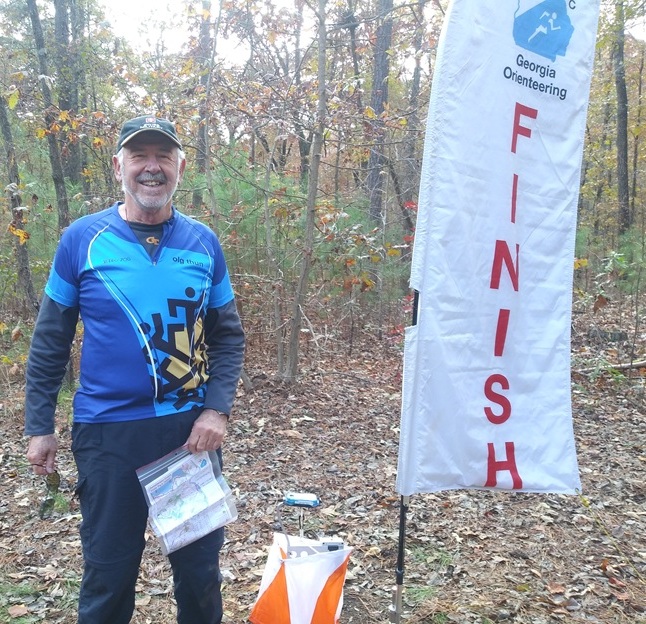
Cheap Thrills. The entry fee for individuals is $7 for club members and $10 for non-members. If you're going out on a course in a small group, the fee for the group is $12 for members and $15 for non-members. An electronic recording device (finger stick) is required; these are available to rent for $3. Also, most parks also have a parking fee or usage fee that you have to pay. (Georgia State Parks charge $10 to park).
6) Is there training available?
We have beginner instruction available at most local events. Preregister for the Beginner Instruction course and show up at the specified time.
7) What should I wear?
For beginners, wear long pants. Long sleeve shirts are also popular. Hikers usually wear sturdy walking shoes. Runners usually wear running shoes. Otherwise just dress for the weather.
8) What kind of compass do I need?
Beginners don't need a compass. It does sort of get in the way when you are trying to learn to read a map. But if you "just gotta have one," bring an inexpensive baseplate compass. The compasses that you "sight" through are not widely used for orienteering.
9) What is a finger stick / E-card / SI-card / dibber?
All are names for the same thing: an electronic card that you carry with you while orienteering. You use the finger stick to record the time you visit each control. See the electronic punching instructions for pictures and to learn how to use the finger stick.
Group Questions
1) Can you come teach my Scouts/Club/Friends to orienteer?
It is much easier for us if you bring your group to one of our events. We get this request all the time, and there is no way that our small group of volunteers can satisfy everyone. We have instruction available at most events.
2) Can we orienteer as a group?
Yes, within reason. Groups larger than 2 quickly become a leader and followers. If the followers want to learn to navigate it's not much fun. Very young groups (Cub Scouts, Brownies) are much better off if an adult accompanies them, and in that case the group can be larger, but no more than 5.
3) How much does it cost for a group to orienteer?
If the group registers as one entry, the cost for the entire group is $12 for GAOC members and $15 for non-members. Groups are limited to 5 people, and each person in the group will receive a map.
4) Why do we need to call (or email) you before we bring a large group to orienteer?
Now that preregistration is required, there is no need to call ahead for large groups. But if you have questions, feel free to call.
5) How can I help GAOC with my group?
When you get to the event, have one person in charge of checking in.
Club Questions
1) You guys are volunteers? You must be crazy.
You too, can be a crazy GAOC volunteer. Spend your weekends away from home. Get leathery wind-burned skin in the winter and heatstroke in the summer. Always have a poison plant rash and insect bites. Carry water jugs into the woods for people to drink. Put out the controls before everyone else arrives and pick them up after everyone else goes home. Get lost trying to find obscure control sites.
Spend a lot of time in the woods. See parts of Georgia (and the world) that others never see. Make a lot of friends. Gain self-confidence. Learn something new. Learn to think while exercising. Have fun. Become a very good navigator.
2) Who makes the maps?
We make the maps. You too, can make maps for the GAOC. See the question above, except that making maps is expensive, and it's not easy, and it takes a lot of time.
3) Will you make a map of my favorite Park/School/Backyard?
The quick answer is No. The real answer is that we have several years worth of projects that we would like to do, and your project, even if it is the greatest place on Earth, would have to wait. Also not every park or school or Boy Scout reservation is suitable. And it costs money. We do have GAOC members who contract their services to make maps. If you're interested, contact the VP of Maps, Kevin Haywood, at haywoodkb at yahoo dot com.
4) How do I volunteer?
We always need volunteers. Start coming to events, introduce yourself to the regulars, and we'll put you to work. You don't have to be an expert orienteer to volunteer. Just let us know. Also, in the registration process there is a request for volunteers. Pick a job you'd like to try. We'll teach you how.
5) Where does the money go?
GAOC is a 501(c)(3) non-profit organization. Our income goes into more maps, equipment, supplies and other event expenses. The overwhelming cost of running an orienteering club is in the maps and they are very valuable. The GAOC maps are copyrighted and may not be copied. When you do copy them, you are stealing from our club.
Intermediate Questions
1) What are the color-coded courses?
This is how we cater to people of different skill levels and ages. Each course is a step up in difficulty and/or length. The following table gives the details for our local events, not for a National Ranking Event (NRE). Typically, we offer White, Yellow, Orange, Silver, Brown, Green and Red courses at our local events. Distances are "straight-line". Actual course distances depend on the individual's route choice.
| Course | Difficulty | Distance | Comments |
|---|---|---|---|
| White | Beginner | < 3K | controls on trails or marked routes |
| Yellow | Advanced beginner | < 3K | controls just off trails or marked routes |
| Orange | Intermediate | ~4-5K | contour features are introduced, trails no longer primary route choice |
| Silver | Expert | ~2-3K | very short expert |
| Brown | Expert | ~4K | short expert |
| Green | Expert | ~5K | medium expert |
| Red | Expert | ~6-7K | expert |
| Blue | Expert | ~7-9K | long expert, rarely seen at a local event. |
2) When do I move up from one course to another?
A difficult question to answer. If you can average 15 to 20 minutes per kilometer you can probably move up, but remember the 3 hour time limit, and ask yourself how long you can realistically concentrate on your navigation. The biggest mistake we see is trying to do too much too soon. A rule of thumb is to successfully complete three courses at one level before moving to the next.
3) What should "MY" course color be?
See the above question. For the local events, it is whatever you are comfortable with. For an NRE, it is your age-group class, see the NRE questions below. We do not do age-groups at the local events, just courses by color.
Competitive Questions
1) How do I compete?
Practice, practice, practice. Get in shape. Come to a bunch of events. Volunteer. Set some courses. Do control pickup. Travel to away events. etc. etc.
2) Do you actually run?
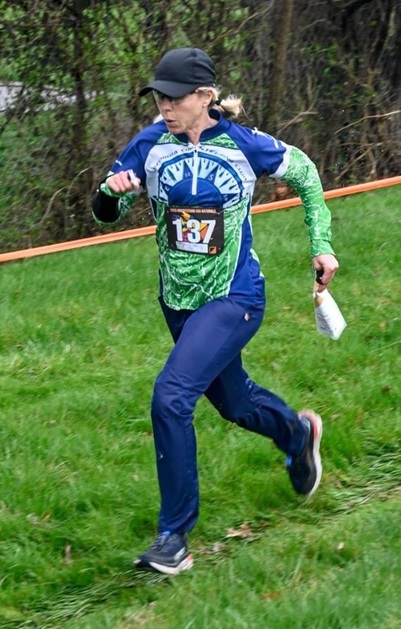
Crazy as it may sound at first, yes we do. It's a lot of fun, really. And we hardly ever get injured. Of course, running through the woods is a lot different than running on a road.
3) How fast do I need to be?
Not very fast to compete at the local events. Ideally, a course should challenge you equally mentally and physically. Actually, most people can run a lot faster than they can orienteer. Anything less than 15 minutes/km at a local event and you can be very competitive. At a national event you need to be doing 10 min/km or less to place well in your age group. In the elite classes it's more like 7-8 min/km. For comparison, a 50 minute 10K is 5 min/km.
4) What are the different types of events?
See the Event Guide for a detailed description. A "regular" orienteering event is point to point, take the controls in order, fastest person wins. A Score-O leaves the order up to the competitor, controls have a point value, most points in shortest time wins. A Night-O is just like regular orienteering, it's just in the dark, and, yes, you bring a flashlight! The Bubba Goat is a mass start, following allowed, skip one control, beat the time limit. There may be other special rules from time to time.
5) What's an NRE? What's an A meet?
An Orienteering USA (OUSA) sanctioned National Ranking Event (NRE), formerly known as an A-meet, has classes based on age, with each class running on a course specifically designed to match abilities of the age class. Awards are given to age group winners. The courses are more carefully set and tested multiple times for accuracy. And, you can earn national ranking points at NREs.
6) What is Orienteering USA? Should I join?
Orienteering USA (OUSA), legally known as United States Orienteering Federation (USOF), is the national governing body of all orienteering activities in the United States. If you are an Orienteering USA member, you get a monthly E-newsletter, an annual magazine, discounts at NRE events, voting rights, and national ranking. If you plan to compete outside Georgia, joining OUSA is probably a good idea.